

The Korean summit, laden with symbolism in everything from the choice of location to the mango mousse for dessert, could just be the first round in a continuing dialogue, says Dr Rajaram Panda.

Even as the United States snuggles closer to India with the thinly veiled objective of containing China, the Indian strategy is to avoid alienating either nation.

'During his visit to Vietnam on September 3 -- the first visit by an Indian prime minister in 15 years -- Modi will notice the widespread anti-China sentiment in that country.'

The India that needs strategic alliances, defence cooperation and engaging meaningfully with neighbouring countries is quietly moving ahead with confidence, says Tarun Vijay

These ambitious projects are littered with every possible acronyms and include proposed road links, air connectivity plans, electricity grids and special economic zones on coasts, says Subhomoy Bhattacharjee.

In spite of irritants and hiccups in the relationship, a few deliverables are expected of the prime minister's visit to China, says Rup Narayan Das.

'China any day would prefer to team up with India and dump Pakistan once the resolution of the border dispute becomes an accomplished fact.'

While China is bigger and feels mightier at the moment, Beijing's rulers would be well advised not to be tempted to provoke India, for that would only trigger a chain reaction around the world that would not serve anyone's interests, says Sanjaya Baru.

'Washington is telegraphing here is its willingness to support a low-grade, limited use of force meant to send a strong message to Pakistan.' 'Perhaps something along the lines of the surgical strikes in 2016, or perhaps something a bit more -- but not much more.'
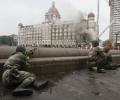
Through its early days to the 1980s, Pakistan sought to expand its sphere of Islamic influence through Afghanistan to Central Asia and got Pakistani citizens recruited in the Afghan government institutions in the 1990s when the Taliban were power. Now, it is looking eastward through India to Bangladesh and Myanmar to establish an imaginary caliphate.

Singh said the terrorists snuck in from the Ravi river.

Rediff.com reproduces this 2014 interview with Tim Kaine where in he discusses the new opportunities to foster Indo-US trade and the improvement in ties.

'Modi's promise of change during the election campaign was on the domestic front, but his first year in office focused on foreign policy beyond all expectations,' says Ambassador T P Sreenivasan.

US Congresswoman Tulsi Gabbard, newly elected co-chair of the influential Congressional Caucus on India and Indian-Americans, discusses her vision for US-India ties with Rediff.com's Monali Sarkar.
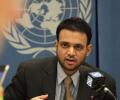
The 36-year-old desi speaks impeccable Arabic and quotes freely from the Quran during his speeches, reports Aziz Haniffa.

'The Senators were playing safe, not angering either the pro-India lobby or the pro-Pakistan lobby, but perhaps more importantly, the military-industrial complex -- the most powerful lobby of all -- which the majority of Senators are beholden to in terms of largesse to their campaign coffers.'

Making it easier to do business is a key element of our strategy, says Foreign Secretary S Jaishankar.

Excerpts from Prime Minister Narendra Modi's speech at the Combined Commanders Conference on board the INS Vikramaditya at sea, off the coast of Kochi.

'If the US-Pakistan relationship continues to suffer, Pakistan may feel it has less to lose and decide that it need not keep a leash on LeT in order to appease America.' 'A tougher US policy toward Pakistan could lead to an emboldened and strengthened LeT and JeM, resulting in more terrorist attacks in India.'

'The book has immense value because it reveals the inner workings of the think-tank which appears to provide facts and insights to Modi, though he himself takes the final decisions and articulates them in his characteristic rhetorical style,' says Ambassador T P Sreenivasan.
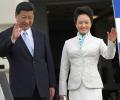
'India and China have to make concrete progress with regard to the border issue, addressing the trade deficit, and facilitating people-to-people interactions. This has to happen in the next two, three years.' China expert Tansen Sen tells Sheela Bhatt/Rediff.com how India and China can take their relations to the next level.

'Diplomatic engagement will continue even as India keeps all its options open with respect to discretely targeting the Pakistani military and its terrorist proxies.'
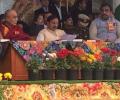
'It is very much a danger.' 'With Tibet following the India tradition of ahimsa and the global visibility of the Dalai Lama who embodies these values, he should be supported by India as a diplomat.' 'It would be in India's self-interest and instead of being embarrassed about his presence, India should recognise this (role).' 'By appeasing China, India does not get anything in return; they (the Chinese have not stopped) claiming Arunachal, part of Kashmir, etc.'

On her last day as India's envoy to the United States, Ambassador Nirupama Rao was felicitated by the Barck Obama administration at the State Department on Monday, with US Secretary of State John F Kerry thanking her for her service toward furthering the strategic partnership between the two nations.

'Devyani -- she is a public servant and her personal life has already received far too much attention -- and her ambitious father now need to retreat to the background so that wiser diplomatic heads restore sanity to India-US relations as India prepares for parliamentary elections,' says Ambassador K C Singh.

'One lesson to emerge out of the Modi-Putin summit is that India can be more self-confident that it possesses inherent strengths to leverage its interlocutors to influence Pakistani policies,' says Ambassador M K Bhadrakumar.

Prime Minister Narendra Modi, who recently completed one year in office, has, in an exclusive interview with Smita Prakash, editor, ANI, said the opposition alleging that his government is a "suit boot ki sarkar" is definitely better and more acceptable than being labelled a "suitcase" (ki sarkar), and satirically added, that after ruling for sixty years, the Congress has suddenly remembered the poor.

Back on the small screen after quite a while, actress Pallavi Kulkarni relates the many unlikely adventures she experienced during her time away from the spotlight.
